Why Does the American West Continue to Captivate Us? More than a century after the frontier closed, the imagery of the American West continues to shape fashion, film, music, art, and popular imagination.
Cowboy boots appear on runways. Western silhouettes return season after season. Contemporary artists reinterpret frontier landscapes, while musicians and filmmakers revisit the mythology of the West for new generations.
Why does a period of history that has long since passed continue to exert such influence on culture today? The answer may lie not in the West itself, but in what it represents.
The Myth of the Frontier
Americana spirit is the belief that change is possible, life can be made better, and that the individual has agency. It is founded upon three fundamental traits: Individualism (belief that each person has the right and duty to shape their own life), Idealism (idea that society can be improved and obstacles are challenges to overcome), and Frontier Mentality (their early settlers constantly pushed into unknown territory). Is it any wonder that the Wild West – the ultimate symbol of the spirit of Americana - would have such an enduring influence on culture?
Fashion as Cultural Memory
Of all the forms of creative human expression – none has been championing the untamed spirit of 19th Century America and its rich cultural legacy since its origins or most consistently than the field of fashion. How did clothing preserve the image of the West long after the frontier disappeared?
Western Wear began as collection of durable but comfortable clothing designed to withstand the harsh conditions of the Wild West. The basics included: a wide-brimmed hat, an ordinary shirt, cowboy vest, cotton or wool pants, leather caps, boots with spurs, and handkerchief around the neck.
Men weren’t the only ones with riding and roping skills – women spent just as much time on the ranch and were just as skilled. They also required practical clothing for their daily routines to the point where they began wearing their husbands, fathers, and brothers’ clothes.
With the introduction of the Wild West in the 1900s, split skirts became increasingly common among western women. This fashion item liberated them to compete with men in various events.
Then in 1910, icons such as Annie Oakley, Calamity Jane, and other women from the Wild West began paving the way for the future of cowgirls’ fashion. This functional attire gradually transformed into a distinctive fashion style recognized worldwide.
Americana in Contemporary Culture
The mythology of the American West continues to evolve rather than disappear. Fashion houses reinterpret cowboy silhouettes, musicians reinvent Western iconography, filmmakers revisit frontier narratives, and contemporary painters imagine the landscape anew. Together they demonstrate that Americana is not frozen in history—it remains an active cultural language.
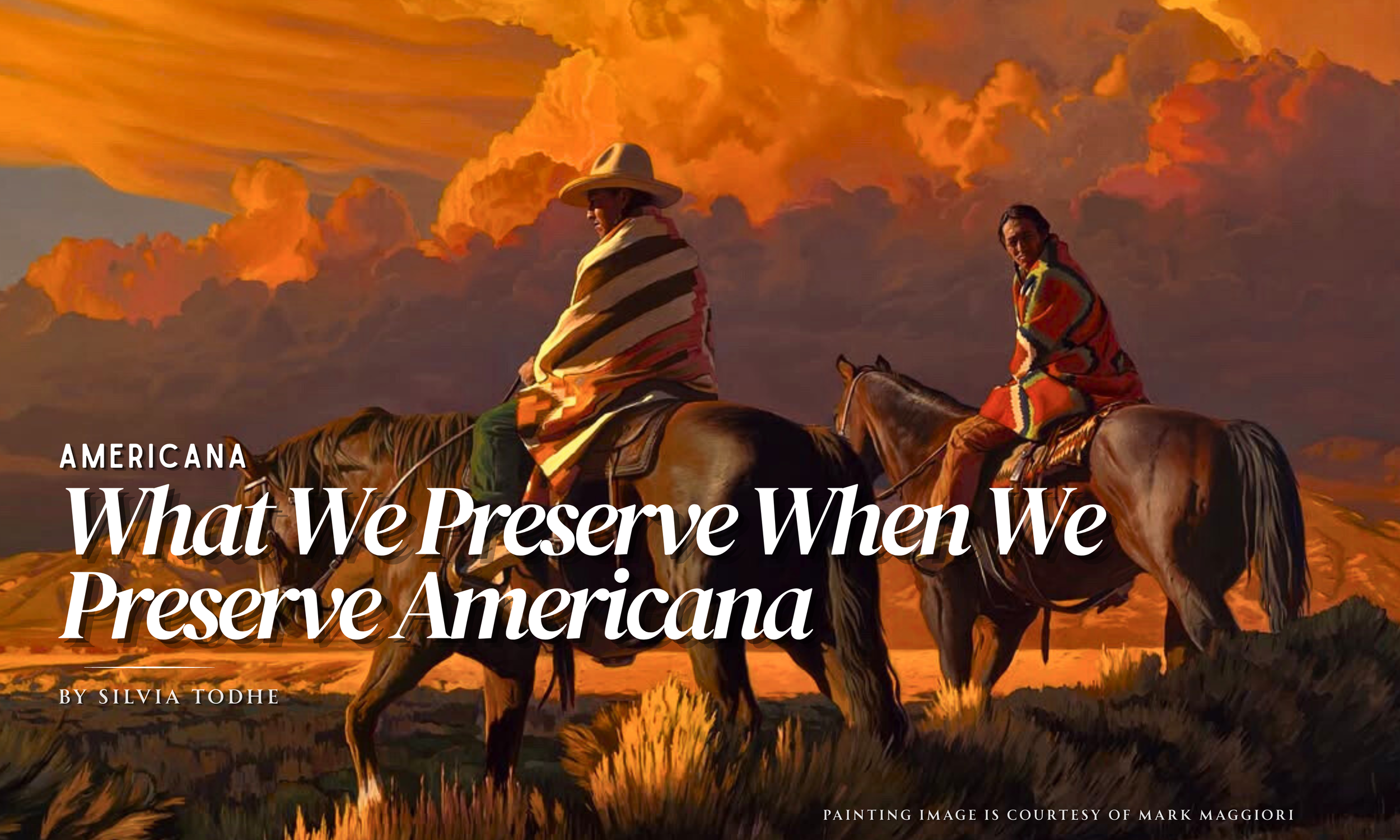
It has inspired fashion, film, literature, music, and visual art alike with recent appearances in pop culture such as ‘Barbie’ Movie (2024) featuring Margot Robbie and Ryan Gosling [Film], Pharrell Williams’ Louis Vuitton Runway Collection Debut [Fashion], Beyonce’s most recent album ‘Cowgirl Carter’ and tour [Music & Entertainment], and Western Landscape Oil Painter Mark Maggioni & Will Cotton’s inspired interpretations of cowboys and girls of the Old West [Arts].
What We Preserve When We Preserve Americana
The enduring popularity of Western fashion is not simply about boots, hats, or denim. It reflects our tendency to preserve cultural myths through objects, stories, images, and design. Long after historical realities fade, symbols remain.
The American West survives not because people remember every detail of its history, but because each generation continues to reinterpret what it represents.
In this way, Western fashion functions much like a museum collection, historic landmark, or archival manuscript. It preserves a story that societies continue to revisit in search of meaning.